

Organ systems are the coordinated groups of organs that carry out the essential functions needed for life. In complex organisms, no single organ works alone. Instead, organs specialize in particular tasks and cooperate with other organs through integrated systems that maintain structure, regulate internal conditions, acquire energy, respond to the environment, and enable growth and reproduction. Understanding organ systems helps explain how living things function as unified wholes rather than as collections of independent parts.
Key Takeaways: Organ Systems
- An organ system is a group of organs that work together to perform a major biological function.
- Humans are commonly described as having 11 organ systems, although the exact number varies by source.
- Organ systems are interdependent and constantly interact to maintain homeostasis.
- Animals show wide variation in organ systems, reflecting different body plans and lifestyles.
- Plants also have organ systems, although they are organized differently from those in animals.
Free Human Organ Systems Study Sheet
This two-page color PDF provides a clear overview of the 11 major human organ systems, identifying each system along with its primary functions and major organs. Designed for middle school, high school, and college-level study, it works well as a classroom reference, study aid, or review sheet.
What Is an Organ System?
An organ system consists of two or more organs that cooperate to carry out a specific, vital function for an organism. Each organ within the system has a specialized role, but the system as a whole accomplishes tasks that individual organs cannot perform alone.
For example, the digestive system includes the mouth, stomach, intestines, liver, and pancreas. Each organ performs a distinct job, but together they allow the organism to ingest food, break it down, absorb nutrients, and eliminate waste.
Organ systems represent a higher level of biological organization, above tissues and organs and below the whole organism.
Levels of Biological Organization
Living organisms are organized into hierarchical levels of increasing complexity. Organ systems occupy a critical position in this hierarchy, linking individual organs to the functioning of the whole organism.
The major levels of biological organization relevant to organ systems are:
Each level builds upon the previous one. Cells specialize into tissues, tissues form organs, and organs cooperate within systems. Organ systems allow division of labor, improved efficiency, and coordinated regulation across the body.
Organ Systems in the Human Body
Humans have highly specialized organ systems that support complex behaviors, long lifespans, and advanced regulation of internal conditions. Most biology textbooks describe 11 major human organ systems, although some sources combine or separate systems differently.
Why the Number of Organ Systems Varies
The number of human organ systems depends on how systems are defined and grouped. Some sources combine the lymphatic and immune systems, while others separate reproductive systems by sex or group the integumentary system differently. Despite these differences, the underlying structures and functions remain the same.
Major Human Organ Systems and Their Functions
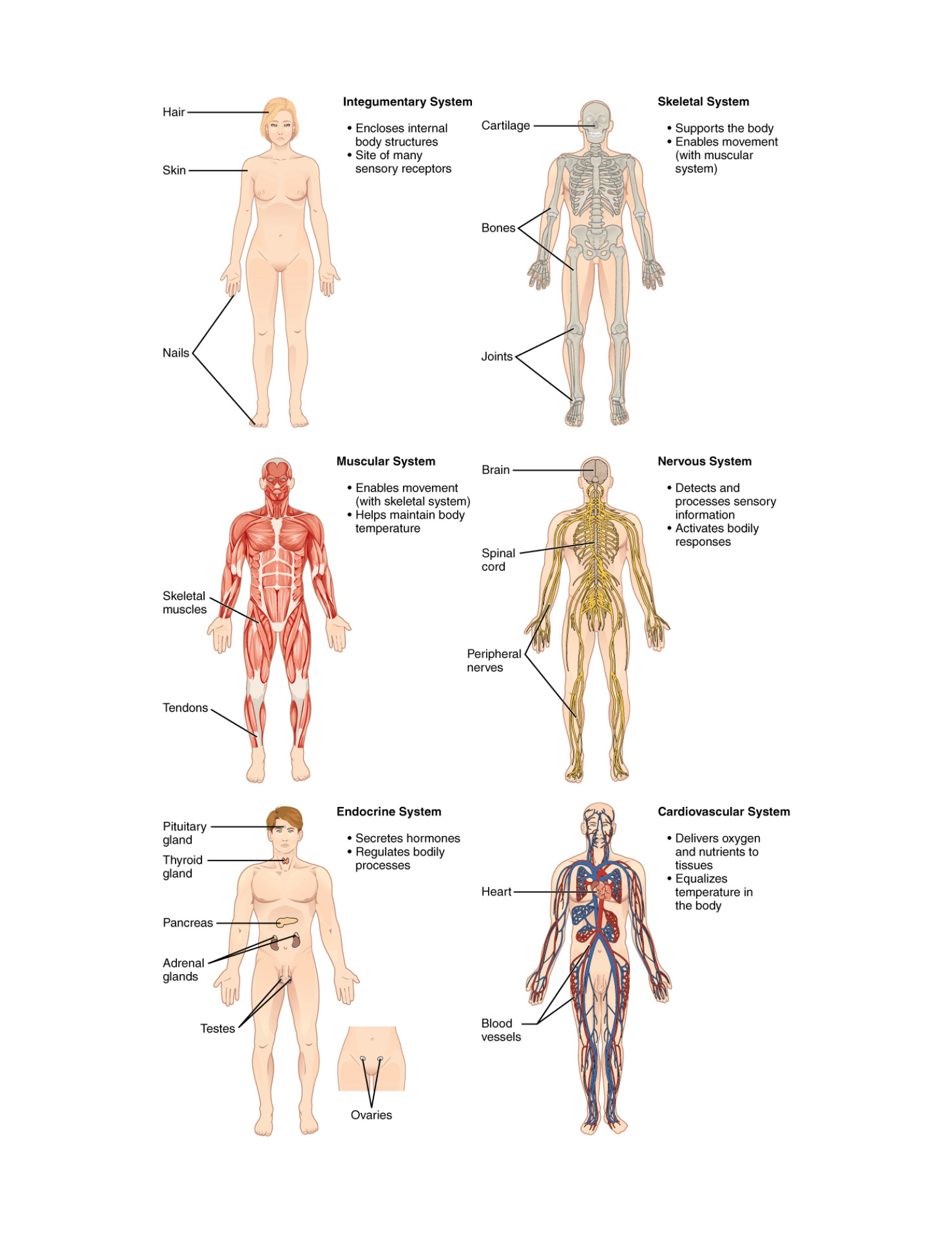
The organ systems of the human body work together to maintain structure, regulate internal conditions, and support life. These systems include the integumentary, skeletal, muscular, nervous, endocrine, cardiovascular, lymphatic (immune), respiratory, digestive, urinary, and reproductive systems. Each system consists of specialized organs that perform distinct roles, but none functions in isolation. Together, they form an integrated network that enables movement, communication, metabolism, defense, waste removal, and reproduction.
Integumentary System
The integumentary system forms the body’s outer covering and serves as the first line of defense against physical injury, pathogens, and water loss. It also plays a role in temperature regulation, vitamin D synthesis, and sensory perception.
Major organs: Skin, hair, nails, sweat glands, oil glands
Skeletal System
The skeletal system provides structural support and protection for internal organs while enabling movement in conjunction with muscles. It also plays essential roles in blood cell production and mineral storage.
Major organs: Bones, cartilage, ligaments, joints
Muscular System
The muscular system allows movement of the body and internal organs. It also maintains posture, stabilizes joints, and generates heat to help regulate body temperature.
Major organs: Skeletal muscles, smooth muscle, cardiac muscle, tendons
Nervous System
The nervous system is the body’s primary control and communication system. It detects stimuli, processes information, and coordinates rapid responses throughout the body.
Major organs: Brain, spinal cord, peripheral nerves, sensory organs
Endocrine System
The endocrine system regulates long-term processes such as growth, metabolism, reproduction, and development by releasing hormones into the bloodstream.
Major organs: Hypothalamus, pituitary gland, thyroid gland, adrenal glands, pancreas, ovaries, testes, pineal gland
Cardiovascular System
The cardiovascular system transports oxygen, nutrients, hormones, and waste products throughout the body. It is essential for cellular respiration, immune function, and temperature regulation.
Major organs: Heart, blood, blood vessels (arteries, veins, capillaries)
Lymphatic / Immune System
The lymphatic and immune system maintains fluid balance, absorbs dietary fats, and defends the body against pathogens. It plays a central role in immune surveillance and response.
Major organs: Lymph nodes, lymphatic vessels, spleen, thymus, tonsils, bone marrow
Respiratory System
The respiratory system enables gas exchange between the body and the environment. It supplies oxygen for cellular respiration and removes carbon dioxide produced by metabolism.
Major organs: Lungs, trachea, bronchi, bronchioles, alveoli, diaphragm
Digestive System
The digestive system breaks down food into nutrients that can be absorbed and used by the body. It also eliminates indigestible waste.
Major organs: Mouth, esophagus, stomach, small intestine, large intestine, liver, pancreas, gallbladder
Urinary System
The urinary system removes metabolic wastes from the blood and regulates water balance, electrolytes, and blood pH.
Major organs: Kidneys, ureters, urinary bladder, urethra
Reproductive System
The reproductive system produces gametes and sex hormones and enables reproduction. Its structures differ between males and females but serve complementary roles.
Major organs:
- Male: Testes, epididymis, vas deferens, prostate, penis
- Female: Ovaries, fallopian tubes, uterus, cervix, vagina
Summary Table of Human Organ Systems
| Organ System | Major Organs | Primary Functions |
|---|---|---|
| Integumentary | Skin, hair, nails, sweat glands | Protection, temperature regulation, sensory input |
| Skeletal | Bones, cartilage, ligaments | Support, protection, movement, blood cell formation |
| Muscular | Skeletal, smooth, and cardiac muscles | Movement, posture, heat production |
| Nervous | Brain, spinal cord, nerves | Rapid communication, control, sensation |
| Endocrine | Hormone-producing glands | Long-term regulation, growth, metabolism |
| Cardiovascular | Heart, blood, blood vessels | Transport of oxygen, nutrients, wastes, hormones |
| Lymphatic / Immune | Lymph nodes, spleen, thymus | Fluid balance, immune defense |
| Respiratory | Lungs, trachea, bronchi | Gas exchange |
| Digestive | Mouth, stomach, intestines, liver | Nutrient digestion and absorption |
| Urinary | Kidneys, bladder, ureters | Waste removal, fluid and pH balance |
| Reproductive | Ovaries/testes and associated organs | Production of gametes and hormones |
Organ Systems and Homeostasis
One of the most important roles of organ systems is maintaining homeostasis, the stable internal conditions required for survival.
Homeostasis depends on constant interaction among organ systems. The respiratory and circulatory systems regulate gas exchange, the nervous and endocrine systems coordinate control and communication, and the urinary system works with others to maintain fluid and chemical balance.
Most homeostatic control relies on feedback mechanisms. When these systems fail to regulate internal conditions, disease often results.
How Organ Systems Work Together
Organ systems do not operate independently. They interact continuously to support movement, metabolism, regulation, and reproduction.
Examples include:
- Respiratory and cardiovascular systems transporting oxygen
- Nervous and endocrine systems coordinating responses
- Digestive, circulatory, and urinary systems managing nutrients and waste
- Muscular and skeletal systems enabling movement
Tips to Help Students Remember the Organ Systems
Remembering the names, functions, and relationships of the organ systems is easier when students focus on patterns and connections rather than memorization alone.
One effective strategy is to use mnemonic devices that list the systems in a logical order. For example, the phrase
“I See Muscles Never Eat Cold Leftover Pizza Rolls”
can help students recall the sequence: Integumentary, Skeletal, Muscular, Nervous, Endocrine, Cardiovascular, Lymphatic, Pulmonary (Respiratory), Digestive, Urinary, Reproductive. Students often remember mnemonics best when they create their own.
Another helpful approach is to group related organ systems by function. For instance, the skeletal, muscular, and integumentary systems can be studied together as support, protection, and movement systems. Similarly, the nervous and endocrine systems are often grouped as control and communication systems, while the cardiovascular, respiratory, digestive, and urinary systems can be grouped as transport, exchange, and regulation systems.
Visual learning also plays a major role. Labeling diagrams, color-coding systems, and tracing how substances such as oxygen, nutrients, or hormones move through multiple systems reinforces understanding of system interactions.
Finally, focusing on how systems work together rather than studying them in isolation improves long-term retention. For example, tracing how eating a meal involves the digestive, circulatory, endocrine, and urinary systems helps students see organ systems as an integrated network rather than as separate lists to memorize.
- Use mnemonics
- Group related systems
- Study systems by function
- Label diagrams
- Focus on system interactions rather than memorization
Development of Organ Systems (Embryology Overview)
Organ systems develop during embryonic growth through coordinated differentiation and organization of tissues. Early embryos form three germ layers that give rise to specific systems.
Ectoderm forms the nervous system and skin, mesoderm gives rise to muscles, bones, and the circulatory system, and endoderm develops into the digestive and respiratory systems. Because systems develop simultaneously, disruptions often affect multiple systems.
Organ Systems in Other Animals
Organ systems in animals vary widely in structure and complexity, reflecting differences in body plans, environments, and evolutionary history. While many animals share the same basic types of organ systems, the way those systems are organized and function can differ substantially.
Vertebrates, including mammals, birds, reptiles, amphibians, and fish, possess organ systems that are broadly similar to those of humans. These animals typically have well-developed nervous, circulatory, respiratory, digestive, and reproductive systems, although specific organs may differ. For example, fish use gills instead of lungs for gas exchange, and birds have air sacs that increase respiratory efficiency.
Invertebrates often show simpler or highly specialized organ systems. Insects have an open circulatory system and a tracheal system of air tubes rather than lungs. Some animals, such as flatworms, lack a circulatory or respiratory system altogether and rely on diffusion to exchange gases and nutrients.
Despite these differences, all animal organ systems serve the same fundamental purposes: obtaining energy, maintaining internal balance, responding to the environment, and enabling reproduction.
Organ Systems in Plants
Plants also have organ systems, although they are organized differently from those in animals and lack structures such as muscles, nerves, and circulatory organs like hearts. Instead, plant organ systems are adapted for photosynthesis, transport, support, growth, and reproduction.
Most plants have two main organ systems:
Root System
The root system anchors the plant in the soil and absorbs water and dissolved minerals. It also often serves as a storage site for carbohydrates and other nutrients.
Primary functions:
- Anchorage and support
- Absorption of water and minerals
- Storage of food reserves
Major components:
- Roots (primary root, lateral roots, root hairs)
Shoot System
The shoot system includes all above-ground parts of the plant and is responsible for photosynthesis, reproduction, and transport of substances throughout the plant.
Primary functions:
- Photosynthesis
- Transport of water, minerals, and sugars
- Reproduction and seed formation
Major components:
- Stems
- Leaves
- Flowers, fruits, and seeds
Within these systems, plants contain specialized tissues such as xylem and phloem, which transport water, minerals, and sugars throughout the organism. Coordination in plants occurs through growth responses and chemical signaling rather than rapid electrical communication, but the underlying principle of integrated organ systems remains the same.
Common Misconceptions About Organ Systems
- Each organ belongs to only one system
- Organ systems work independently
- Plants do not have organ systems
- The number of human organ systems is fixed
- All organisms have organs and organ systems
Frequently Asked Questions
Do all organisms have organ systems?
No. Only multicellular organisms have organs and organ systems.
Do some organs belong to more than one organ system?
Yes. Some organs perform roles in more than one system. For example, the pancreas is part of both the digestive and endocrine systems, and the ovaries and testes belong to the reproductive and endocrine systems.
Why is homeostasis important?
It keeps internal conditions within ranges necessary for life.
Which organ system is most important?
All systems are essential and interdependent.
Can organ systems repair themselves?
Some tissues regenerate well, while others have limited repair capacity.
References and Further Reading
- Betts, J Gordon; et al. (2013). “Structural Organization of the Human Body“. Anatomy and Physiology. OpenStax. ISBN 978-1-947172-04-3.
- Hillis, David M.; Sadava, David; Hill, Richard W.; Price, Mary V. (2014). Principles of Life (2nd ed.). Sunderland, Mass.: Sinauer Associates. ISBN 978-1464175121.
- Solomon, Eldra P.; Berg, Linda R.; Martin, Diana W. (2002). Biology (6th ed.). Brooks/Cole. ISBN 0-534-39175-3.
- Widmaier, E. P.; Raff, H.; Strang, K.T. (2014). Vander’s Human Physiology (12th ed.). McGraw-Hill Higher Education. ISBN 978-0-07-128366-3.