
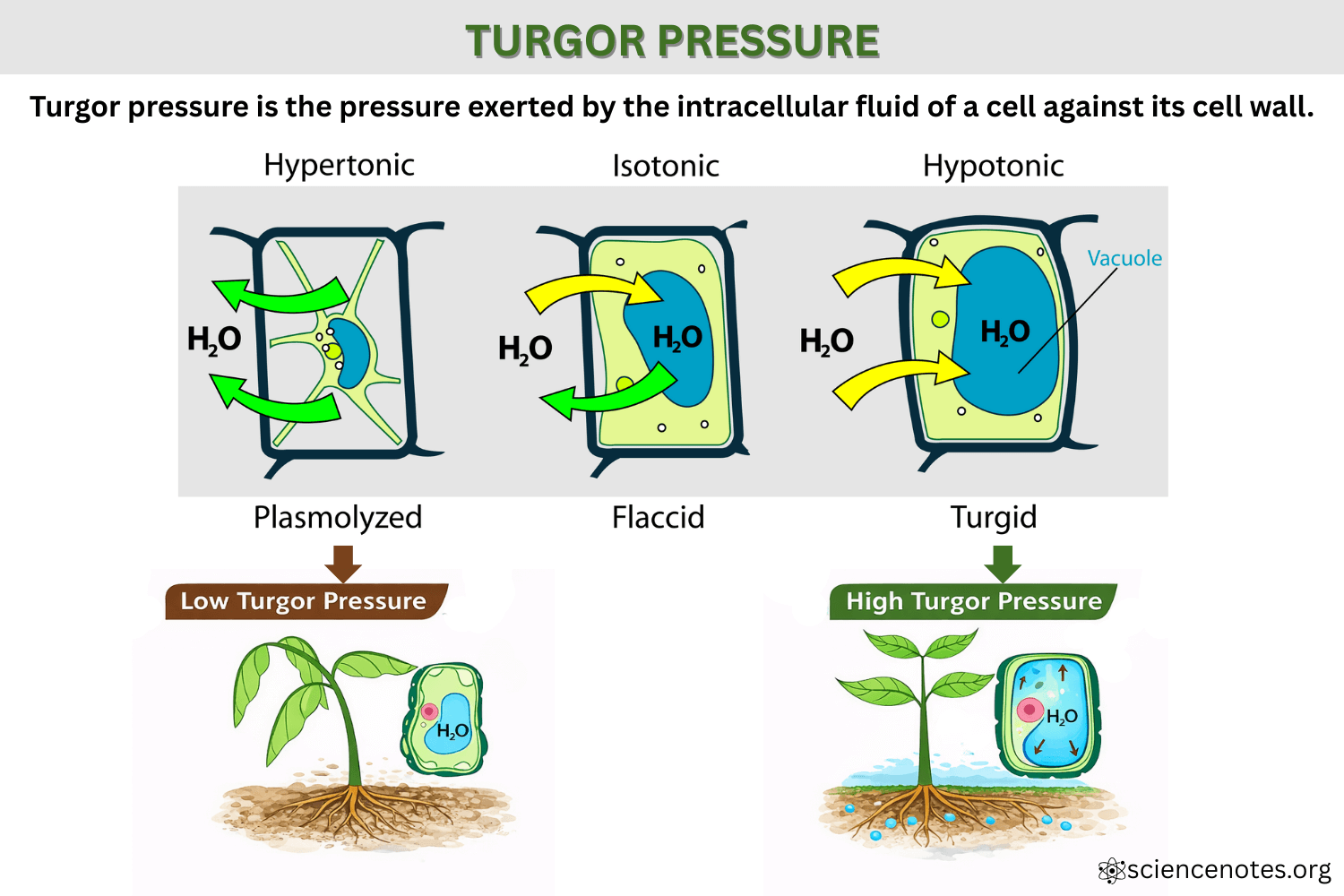
Turgor pressure, also called hydrostatic pressure, is the pressure exerted by fluid within a cell against its surrounding boundary. In biology, the term most often refers to the pressure of water inside a walled cell, especially plant cells, pushing outward against the cell wall. Turgor pressure is essential for maintaining cell shape, supporting plant tissues, driving growth, and enabling many forms of movement in living organisms. Although it is most familiar from plant biology, hydrostatic pressure plays important roles across biology, from fungi and protists to animal physiology.
Key Takeaways: Turgor Pressure
- Turgor pressure is the outward pressure of cell contents against a cell wall.
- It arises primarily from osmosis, the movement of water across a semipermeable membrane.
- In plants, turgor pressure maintains rigidity, drives growth, and enables movements such as opening and closing stomata.
- Too little turgor pressure leads to wilting or plasmolysis, while excessive pressure can damage cells.
- Hydrostatic pressure also functions in fungi, protists, cyanobacteria, and animal physiology.
Definition of Turgor Pressure
Turgor pressure is the pressure exerted by the intracellular fluid of a cell against its surrounding cell wall. It results when water enters the cell by osmosis, causing the plasma membrane to press outward. In walled cells, such as those of plants, fungi, and many microorganisms, this pressure counterbalances the inward force of the cell wall, producing a firm, stable structure.
In a broader physical sense, hydrostatic pressure refers to the pressure exerted by any fluid at rest due to its weight and confinement.
Units and Typical Magnitudes
Turgor pressure uses standard pressure units:
- Pascals (Pa), the SI unit
- Kilopascals (kPa), commonly used in biology
- Megapascals (MPa), often used for plant cells
- Bars or atmospheres (atm), sometimes used in older sources
Typical plant cell turgor pressures often fall in the range 0.1 to 1.0 MPa, depending on tissue type, developmental state, and environmental conditions. For perspective, 1 MPa is about 10 atmospheres, which underscores how significant these internal forces can be.
Examples of Turgor Pressure
Examples make turgor pressure feel less abstract. You can connect it to familiar observations, plus a few less obvious biological processes that depend on pressure inside cells.
- Crisp lettuce leaves: High turgor pressure keeps cells firm, giving leaves their crunch.
- Wilting plants: Loss of turgor pressure causes leaves and stems to droop.
- Guard cells: Changes in turgor pressure open and close stomata.
- Fungal hyphae: Turgor pressure drives tip growth and penetration of substrates.
- Protist water balance: Contractile vacuoles help regulate internal pressure and prevent bursting in freshwater.
- Cyanobacterial filaments: Internal pressure helps maintain shape and integrity, especially under osmotic stress.
Mechanism: How Turgor Pressure Works
This section links the biology of cells to the physics of fluids and membranes. The mechanism is simple in outline but includes important details about equilibrium and forces that help explain plant responses to drought and salinity.
Turgor pressure arises from the interaction of three main factors:
- A semipermeable plasma membrane
The plasma membrane allows water to pass relatively easily, especially through aquaporins, while restricting many solutes. - An osmotic gradient
Solutes inside the cell lower its tendency to lose water. If the outside environment has a higher water potential than the cell interior, water enters. - A mechanically resisting boundary
In walled cells, the cell wall resists expansion. In non-walled cells, the membrane and cytoskeleton provide limited resistance.
As water enters, the cell contents expand and push the membrane outward. The wall pushes back. Pressure builds until the system reaches turgor equilibrium, where the outward pressure potential balances the driving forces for water influx.
Osmosis and Water Potential
Plant physiologists often describe this with water potential (Ψ), which predicts the direction water moves:
- Ψₛ (solute potential) becomes more negative as solute concentration increases.
- Ψₚ (pressure potential) is the turgor pressure contribution.
- Ψg (gravitational potential) becomes important over height differences, such as in tall trees.
Water moves from higher Ψ (less negative) to lower Ψ (more negative). As water enters a cell, Ψₚ increases, eventually reducing the net driving force for additional water entry.
Why a Cell Wall Matters
A key point is that turgor is stable only when a cell can resist expansion. Without a wall, water influx tends to swell the cell until it bursts or until ion transport restores balance. Walled cells convert osmotic influx into usable mechanical pressure.
Cell Wall Mechanics and Elasticity
Turgor pressure does not act alone. How the wall responds determines whether pressure produces rigidity, reversible stretching, or irreversible growth. This is where biology turns into biomechanics.
The cell wall behaves like a composite material:
- Elastic behavior allows reversible changes in volume and shape.
- Viscoelastic behavior means the wall deforms over time under constant force.
- Plastic deformation permits irreversible expansion during growth.
Plant cells often grow when enzymes and wall-modifying proteins, including expansins and wall-loosening processes, increase wall extensibility. Turgor provides the pushing force, while the wall’s structure and chemistry determine the direction and extent of expansion.
Regulation of Turgor Pressure
Cells continually adjust turgor because water availability and solute conditions change. Regulation occurs at multiple scales, from ion channels in a single cell to whole-plant responses coordinated by hormones.
Cells regulate turgor pressure through several mechanisms:
- Ion transport: Cells adjust potassium, chloride, and other ions to change osmotic potential.
- Compatible solutes: Sugars, amino acids (for example, proline), and other osmolytes help cells retain water without disrupting proteins.
- Aquaporins: Water channels change membrane water permeability and allow rapid response.
- Cell wall remodeling: Adjusting wall stiffness changes how much pressure translates into expansion versus rigidity.
At the organism level, plants regulate turgor via:
- Root water uptake and transport through xylem
- Transpiration control via stomata
- Hormonal signaling, especially abscisic acid during water stress
What Happens When Turgor Pressure Is Too Low?
Low turgor is one of the most visible examples of cell physiology affecting the whole organism. It explains wilting, slowed growth, and many stress responses to drought and salinity.
Low turgor pressure occurs when cells lose water:
- Flaccid cells: Cells become soft and lose rigidity.
- Wilting: Leaves and stems droop because tissues lack structural support.
- Reduced growth: Cell expansion and elongation slow or stop.
- Loss of physiological function: Stomata may close, reducing CO₂ uptake and photosynthesis.
Plasmolysis
In strongly hypertonic environments:
- Water exits the cell.
- The plasma membrane pulls away from the wall.
- The cell may survive briefly, but normal function is impaired.
Plasmolysis is especially relevant to salt stress, dehydration, and osmotic shock.
What Happens When Turgor Pressure Is Too High?
High turgor pressure benefits support and growth, but cells must keep it within safe limits. Plants manage pressure largely by regulating solutes and controlling wall properties.
Excessive turgor pressure is less common in healthy walled cells but can occur:
- If the wall is weak or damaged, high pressure can cause rupture.
- During rapid rehydration, pressure may rise quickly before regulation catches up.
- In cells with less robust walls, such as certain young tissues, the risk of mechanical failure increases.
In general, walled cells tolerate high internal pressures better than non-walled cells because the wall is designed to resist tension.
Functions and Importance of Turgor Pressure in Plants
Plants use turgor pressure as both a structural support system and a dynamic control mechanism. It influences how plants stand upright, grow, exchange gases, and respond to the environment.
Structural Support
Turgor pressure acts like a hydraulic skeleton. In herbaceous plants, it supplies much of the support that wood supplies in trees.
Cell Expansion and Growth
Turgor provides the outward force for cell enlargement. Growth occurs when the wall yields in a controlled way, so pressure plus wall loosening drives irreversible expansion.
Stomatal Movement
Guard cells change turgor to open and close stomata:
- Increased guard cell turgor opens stomata for CO₂ uptake.
- Decreased guard cell turgor closes stomata to reduce water loss.
Short-Distance Transport and Cytoplasmic Streaming
Within cells and tissues, turgor supports streaming and helps maintain gradients that influence local transport processes.
Seed Dispersal and Reproductive Mechanisms
Turgor pressure also plays a direct role in seed dispersal and plant reproduction. In several plant species, cells in specialized tissues build up high internal pressure as water enters by osmosis. When structural constraints suddenly release, this stored pressure converts into mechanical force. The rapid change in turgor causes fruits, seed pods, or capsules to split open, bend, or snap, ejecting seeds away from the parent plant. This mechanism improves dispersal distance, reduces competition with the parent, and increases the likelihood of successful colonization. Turgor-driven seed release is especially important in species that rely on ballistic dispersal, where seeds launch without the aid of wind or animals.
Plant Movements
Some movements rely on controlled changes in turgor, including leaf folding and pulvinus-based movements. These responses can occur quickly because cells can shift ions and water rapidly.
Hydrostatic Pressure in Humans
Humans do not use turgor pressure to stiffen tissues the way plants do, but hydrostatic pressure is central to circulation and fluid balance. This section connects the term “hydrostatic pressure” to the physiology students already encounter.
Hydrostatic pressure in humans includes:
- Blood pressure: Drives blood flow through vessels.
- Capillary hydrostatic pressure: Promotes fluid movement out of capillaries into tissues.
- Oncotic vs hydrostatic balance: Protein-driven osmotic pressure pulls fluid back into capillaries.
- Cerebrospinal fluid pressure: Cushions and stabilizes the central nervous system.
- Intraocular pressure: Maintains eye shape and proper optics.
Hydrostatic pressure is essential, but too much or too little contributes to disease, such as edema, glaucoma, or hypertension-related complications.
Turgor Pressure in Other Organisms
Turgor and related internal pressures are widespread in biology. Where organisms have walls or strong outer layers, internal pressure becomes a powerful way to generate force, shape, and motion.
Fungi
Fungal cells use turgor pressure for:
- Hyphal tip growth
- Penetration of substrates and host tissues
- Spore discharge in some groups
Some fungi generate very high turgor pressures to push through tough materials, which helps explain how plant-pathogenic fungi invade tissues.
Protists
Many protists live in freshwater, where water continually enters cells by osmosis. They manage internal pressure through:
- Contractile vacuoles that pump water out
- Osmoregulation via solute control
- Cytoskeletal support that helps resist deformation
Turgor-related pressure also contributes to feeding mechanisms and shape changes in certain protists.
Diatoms
Diatoms have rigid silica frustules. Turgor pressure:
- Maintains internal structure against the frustule
- Contributes to cell expansion and division processes where wall formation is coordinated with internal pressure
Cyanobacteria
Cyanobacteria regulate internal pressure to:
- Maintain cell shape
- Survive changing salinity
- Support filament structure in multicellular forms
Osmolyte accumulation is especially important for cyanobacteria in environments where external solute concentration changes rapidly.
Animals and Hydrostatic Skeletons
Animal cells lack cell walls, so individual cells do not maintain plant-like turgor. However, many animals use hydrostatic pressure at the tissue or body level:
- Worms, sea anemones, and many soft-bodied invertebrates use hydrostatic skeletons.
- Muscles push against fluid-filled compartments to produce movement.
In animal cells, volume and pressure are controlled through ion pumps, membrane transport, and the cytoskeleton to prevent lysis.
Methods of Measuring Turgor Pressure
Measuring turgor pressure ranges from direct measurements in individual cells to indirect estimates using osmotic behavior and tissue-level techniques. The best method depends on cell size, accessibility, and whether the measurement needs to be non-destructive.
Pressure Probe
A microcapillary probe can directly measure pressure inside a living cell. This method is highly informative but technically demanding and best suited to larger cells.
Osmotic Methods
Cells or tissues are placed in solutions of known osmotic strength. When there is no net water movement, researchers infer internal osmotic and pressure conditions.
Plasmolysis-Based Estimation
Researchers determine the external concentration that causes incipient plasmolysis and use it to estimate internal solute potential and pressure potential.
Pressure Chamber
A pressure chamber on leaves or shoots estimates water status. While it does not measure single-cell turgor directly, it provides valuable tissue-level information closely related to pressure dynamics.
Atomic Force Microscopy
AFM measures cell wall deformation under controlled force. Combining deformation data with wall properties allows estimation of internal pressure, particularly in small cells.
Frequently Asked Questions
Is turgor pressure the same as osmotic pressure?
No. Osmotic pressure is the driving tendency for water movement due to solute concentration. Turgor pressure is the mechanical pressure that results when water influx presses contents against a resisting wall.
Does negative turgor pressure exist?
Sustained negative turgor pressure in living plant cells is generally not supported. As pressure falls toward zero, the membrane loses tight contact with the wall rather than transmitting sustained tension. Negative pressures are well known in xylem sap under tension during transpiration, but that is a different compartment and mechanism than intracellular turgor.
Why does salting soil harm plants?
High external solute concentration lowers the water potential outside roots, pulling water out of cells and reducing turgor, which leads to wilting and physiological stress.
Can a plant recover turgor after wilting?
Often yes, if dehydration is not severe. Rewatering restores water potential gradients and allows cells to regain pressure, though prolonged stress can cause irreversible damage.
Do all plant tissues rely equally on turgor for support?
No. Woody tissues rely more on lignified cell walls, while herbaceous tissues rely heavily on turgor.
Glossary
- Aquaporin: A membrane protein that facilitates rapid water transport across cell membranes.
- Cell Wall: A rigid extracellular structure that provides support and protection in plants, fungi, and many microorganisms.
- Compatible Solute (Osmolyte): A small molecule that helps cells maintain osmotic balance without disrupting proteins.
- Flaccid: The state of a cell with low turgor pressure, resulting in softness and reduced rigidity.
- Hydrostatic Pressure: Pressure exerted by a fluid at rest within a confined space or against a boundary. In biology it applies to pressures in vacuoles, blood vessels, tissues, and other fluid-filled spaces.
- Hypertonic: Describes an external solution with higher solute concentration (lower water potential) than the cell interior. Water leaves the cell in a hypertonic environment.
- Hypotonic: Describes an external solution with lower solute concentration (higher water potential) than the cell interior. Water enters the cell in a hypotonic environment.
- Isotonic: Describes an external solution with equal effective solute concentration (similar water potential) relative to the cell interior, producing no net water movement.
- Lysis: Rupture of a cell due to excessive swelling and membrane failure. Cells without walls are more vulnerable to lysis in hypotonic environments.
- Osmoregulation: Biological control of internal water and solute balance to maintain cell volume, pressure, and function under changing environmental conditions.
- Osmosis: Movement of water across a semipermeable membrane driven by differences in water potential or solute concentration.
- Osmotic Pressure: The pressure needed to prevent osmosis; related to solute concentration.
- Plasmolysis: Separation of the plasma membrane from the cell wall due to water loss in a hypertonic environment.
- Pressure Potential (Ψₚ): The component of water potential associated with physical pressure, including turgor.
- Solute Potential (Ψₛ): The component of water potential related to dissolved solutes; becomes more negative as solute concentration increases.
- Turgid: The state of a cell with high turgor pressure, making it firm and rigid.
- Turgor Pressure: The outward pressure exerted by a cell’s internal fluid (mainly water in the vacuole and cytoplasm) against the cell wall. It develops when water enters the cell by osmosis and the wall resists expansion.
- Water Potential (Ψ): A measure of water’s tendency to move, combining solute, pressure, and gravitational components.
References and Further Reading
- Kroeger, Jens H.; Zerzour, Rabah; Geitmann, Anja (2011). “Regulator or Driving Force? The Role of Turgor Pressure in Oscillatory Plant Cell Growth”. PLOS ONE. 6 (4) e18549. doi:10.1371/journal.pone.0018549
- Money, Nicholas P. (1995). “Turgor pressure and the mechanics of fungal penetration”. Canadian Journal of Botany. 73 (S1): 96–102. doi:10.1139/b95-231
- Oliver, Roderick Lewis (1994). “Floating and Sinking in Gas-Vacuolate Cyanobacteria1”. Journal of Phycology. 30 (2): 161–173. doi:10.1111/j.0022-3646.1994.00161.x
- Steudle, Ernst (1977). “Effect of Turgor Pressure and Cell Size on the Wall Elasticity of Plant Cells”. Plant Physiology. 59 (2): 285–9. doi:10.1104/pp.59.2.285
- Waggoner, Paul E.; Zelitch, Israel (1965). “Transpiration and the Stomata of Leaves”. Science. 150 (3702): 1413–1420. doi:10.1126/science.150.3702.1413