
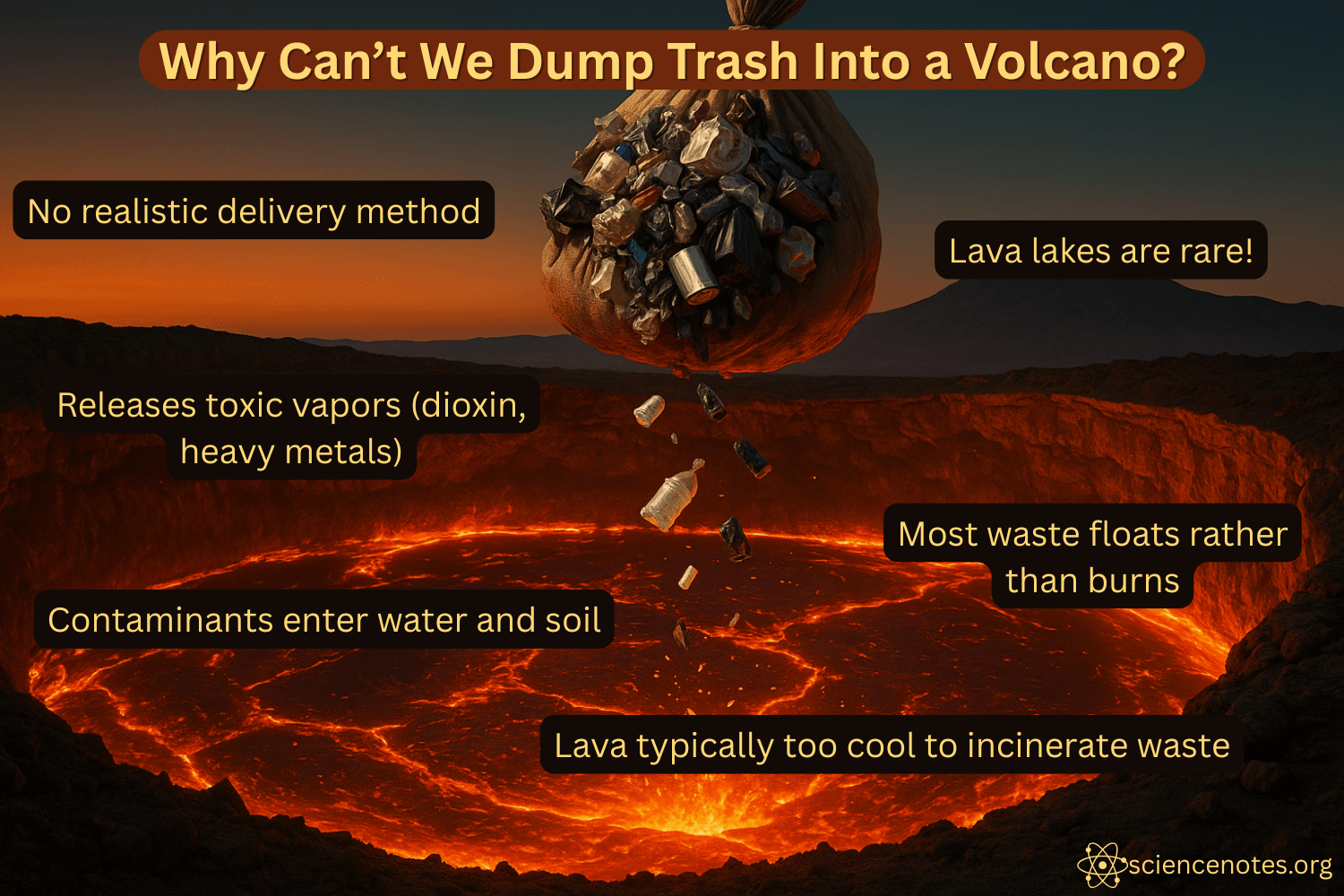
Volcanoes look like nature’s ultimate incinerators, complete with roaring heat and dramatic destruction. The idea of tossing trash or nuclear waste into a bubbling lava lake sounds strangely satisfying. Unfortunately, this method of disposal is deeply flawed. It is limited by geological reality, extreme environmental risks, and serious misconceptions about how volcanoes behave.
Even if it seems intuitive that lava can melt anything, the scientific and logistical challenges make this one of the worst options for waste disposal. Volcanoes are designed by nature to expel material, not contain it. Their emissions are already toxic, but adding garbage makes things worse, not better.
Key Takeaways: Trash Into a Volcano
- Only a few volcanoes worldwide have persistent lava lakes accessible for waste disposal.
- Even then, most lava is not hot enough to burn most trash.
- Volcanoes are unpredictable and designed to release, not store, materials.
- Transporting waste to volcanoes is expensive, dangerous, and counterproductive.
- Nuclear waste cannot be neutralized by lava. Eruption only expands contamination.
- Burning trash adds pollutants not typically found in natural volcanic gases.
Why People Think Volcano Disposal Is a Good Idea
There are several reasons people mistakenly believe volcanoes could serve as effective garbage disposal sites:
- Lava looks unstoppable. It seems capable of destroying anything instantly.
- It mimics natural destruction. Since volcanoes already emit gases and eject material, adding trash might feel like a harmless extension of this process.
- It hides the problem. Throwing trash into lava gives the illusion that it disappears permanently.
These assumptions overlook key scientific, logistical, and environmental realities.
Suitable Volcanoes for Trash Disposal
There are over 1,600 active volcanoes on land, but only a handful have persistent, accessible lava lakes. These features are rare, hazardous, and often located in remote or politically unstable areas. At any given time, only three to seven volcanoes worldwide may host a continuous lava lake.
What Makes a Volcano “Suitable”?
- Persistent lava lake: Requires a stable surface pool of molten rock visible at the crater.
- Open geometry: A wide, accessible crater with minimal explosive activity.
- Geological consistency: Basaltic, low-viscosity lava found in shield volcanoes is hotter, more fluid, and less explosive.
- Location and logistics: Accessible volcanoes with infrastructure are rare.
Examples of Potential Candidates
| Volcano | Location | Type | Lava Lake Status | Notes |
|---|---|---|---|---|
| Kīlauea | Hawaii, USA | Shield | Intermittent since 2008 | Most studied, relatively accessible |
| Erta Ale | Ethiopia | Shield | Long-lived | Remote, thin basaltic lava |
| Nyiragongo | DR Congo | Stratovolcano | Persistent (until 2021) | Extremely fast lava flows, high risk |
| Villarrica | Chile | Stratovolcano | Intermittent | Known for dangerous explosive activity |
| Masaya | Nicaragua | Complex | Active intermittently | Close to urban areas, regularly monitored |
Most volcanoes do not meet these criteria. Many are sealed by plug domes, erupt explosively, or erupt rarely. Shield volcanoes are most likely to have open, fluid lava lakes, but these are extremely rare and often remote.
Trash Does Not Always Burn Completely
Lava is very hot, but not uniformly so, and not everything combusts efficiently in an open environment. Basically, most volcanoes do not produce lava that is hot enough for waste incineration.
Temperature Requirements for Incineration
- Typical waste incinerators operate at 850 to 1,100 °C
- Hazardous waste incineration may require up to 1,200 °C
- Plastics combust between 600 to 1,000 °C
- Some metals melt only above 1,300 to 1,500 °C
Lava Temperature Ranges
| Lava Type | Temperature (°C) | Description |
|---|---|---|
| Basaltic | 1,000 to 1,200 | Low silica, very fluid |
| Andesitic | 800 to 1,000 | Intermediate silica |
| Rhyolitic | 650 to 800 | High silica, viscous, explosive |
Basaltic lava from shield volcanoes is hot enough to burn or melt some waste, but not all. Rhyolitic and andesitic lavas, typical of stratovolcanoes, may not reach temperatures necessary for full combustion of synthetic or industrial materials.
What Happens When Waste Enters Lava?
- Organic materials burn quickly.
- Plastics melt and emit dioxins and other toxins.
- Glass and ceramics soften but often remain intact.
- Metals like steel and copper may not melt at all.
- Electronics and batteries potentially explode or release toxic heavy metals.
The result is incomplete combustion, leading to pollution rather than clean destruction.
Comparing Volcanic Gases to Waste Emissions
Volcanoes naturally emit gases such as water vapor, carbon dioxide, sulfur dioxide, hydrogen chloride, and hydrogen sulfide. These are harmful in large quantities but mostly dilute into the atmosphere or form aerosols and acid rain over time.
Burning garbage in a volcano adds pollutants not commonly found in volcanic gases.
Common Volcanic Gases
| Gas | Typical Concentration | Environmental Effect |
|---|---|---|
| Water vapor | 50 to 90 percent | Harmless in most cases |
| Carbon dioxide | 10 to 40 percent | Greenhouse gas, asphyxiation risk |
| Sulfur dioxide | 1 to 5 percent | Acid rain, respiratory hazard |
| Hydrogen chloride | Trace | Acid rain contributor |
| Hydrogen sulfide | Trace | Toxic at high concentrations |
Added Pollutants from Trash
| Pollutant | Waste Source | Effect |
|---|---|---|
| Dioxins and furans | PVC, plastics | Carcinogenic, endocrine disruption |
| Heavy metals (Hg, Cd, Pb) | Electronics, batteries | Neurotoxic, bioaccumulative |
| Polycyclic hydrocarbons | Mixed combustibles | Persistent, mutagenic pollutants |
| Hydrochloric acid gases | PVC, chlorinated polymers | Respiratory and tissue damage |
| Microplastics | Synthetic fibers and plastics | Ubiquitous, hard to remove from water |
Why This Matters
While volcanic emissions are dangerous on their own, burning trash introduces novel and persistent toxins. These emissions are uncontrolled and unfiltered, leading to immediate and long-term environmental harm. Unlike natural gases, synthetic pollutants do not break down easily and can bioaccumulate in ecosystems.
Why We Can’t Throw Nuclear Waste Into a Volcano
Nuclear waste poses a much greater risk than ordinary garbage. The suggestion that lava could destroy or contain it is entirely unsupported by physics and environmental science.
Heat Cannot Neutralize Radioactivity
- Radioactivity results from unstable atomic nuclei, not molecular bonds.
- No amount of heat can “burn away” radioactivity.
- Lava, at 1,000 to 1,200 °C, is far cooler than the temperatures required to induce nuclear reactions or accelerate decay.
Contamination Risk
- If waste reaches a magma chamber, radioactive material could be ejected during an eruption.
- Volcanic ash can travel hundreds or thousands of kilometers, contaminating air, water, and agriculture.
- Fine particles of radioactive material are especially dangerous when inhaled or ingested.
Geologic Instability
- Volcanoes are highly dynamic. Waste placed in or near a vent may not stay buried.
- Hydrothermal systems can transport radioactive material into aquifers.
- Crustal movement may expose stored waste or vent it unexpectedly.
Better Alternatives
- Deep geological repositories use engineered barriers, stable bedrock, and isolation from the biosphere.
- These facilities are built to last for tens of thousands of years, far outlasting surface or volcanic disposal concepts.
- Examples include the Waste Isolation Pilot Plant (USA) and Onkalo repository (Finland).
Volcanoes are fundamentally incompatible with the long-term containment and control required for radioactive waste.
Alternative Myths and Misconceptions
Besides volcanoes, there are several other impractical ideas for disposing of waste. All have serious scientific or ethical flaws.
Sending Waste Into Space
- Launch costs exceed $10,000 per kilogram, making this method prohibitively expensive.
- Rocket failures could result in catastrophic reentry or dispersal.
- Space debris accumulation adds additional long-term hazards.
Dropping Waste into Ocean Trenches
- Subduction zones move too slowly to absorb waste in any practical timeframe.
- Deep ocean dumping violates international agreements like the London Convention.
- Ecosystems in deep-sea trenches are still poorly understood and potentially vulnerable.
Using Tectonic Plates
- Placing waste along fault lines assumes it will be carried deep into the mantle.
- In reality, subduction occurs at centimeters per year.
- There’s no guarantee the waste will not be regurgitated by volcanic activity elsewhere.
Burning All Waste
- Incinerators require strict regulation and filtering to avoid pollution.
- Not all materials burn cleanly, and energy recovery is limited.
- Some waste, like electronics and medical supplies, requires specialized treatment.
In short, none of these alternatives match the safety, control, and long-term planning of properly managed disposal and recycling systems.
Do Any Politicians Support This?
Despite the persistent myth, it worth knowing no national government or politician actually thinks volcanoes are a viable waste disposal solution (or at least, no one is proposing any legislation). The idea appears in speculative articles, forums, and fictional settings, but it does not have serious policy traction.
Scientists and waste management experts overwhelmingly reject the concept for both conventional and nuclear waste. The risks far outweigh any perceived benefit.
Conclusion
Throwing trash into a volcano may seem like a dramatic way to eliminate waste, but it is scientifically, environmentally, and logistically unsound. Very few volcanoes are suitable, and those that are introduce severe risks. The heat of lava is insufficient to fully destroy most materials, especially hazardous or radioactive ones. Adding synthetic waste to an already toxic environment amplifies pollution and threatens nearby communities and ecosystems.
For both ordinary and nuclear waste, the safest disposal methods involve engineered containment, long-term planning, and environmental oversight. Volcanoes may be powerful, but they are not garbage disposals.
References and Further Reading
- Feiveson, Harold; Mian, Zia; Ramana, M. V.; von Hippel, Frank (2011). “Managing nuclear spent fuel: Policy lessons from a 10-country study“. Bulletin of the Atomic Scientists.
- Gordon, Helen (April 24, 2017). “Journey deep into the Finnish caverns where nuclear waste will be buried for millenia“. Wired.
- McKinnon, Mika (May 12, 2014). “Volcano as Garbage Disposal“. Gizmodo.
- Tomita, Andrew; Cuadros, Diego F; Burns, Jonathan K; Tanser, Frank; Slotow, Rob (2020). “Exposure to waste sites and their impact on health: a panel and geospatial analysis of nationally representative data from South Africa, 2008–2015”. The Lancet. Planetary Health. 4 (6): e223 – e234. doi:10.1016/S2542-5196(20)30101-7