
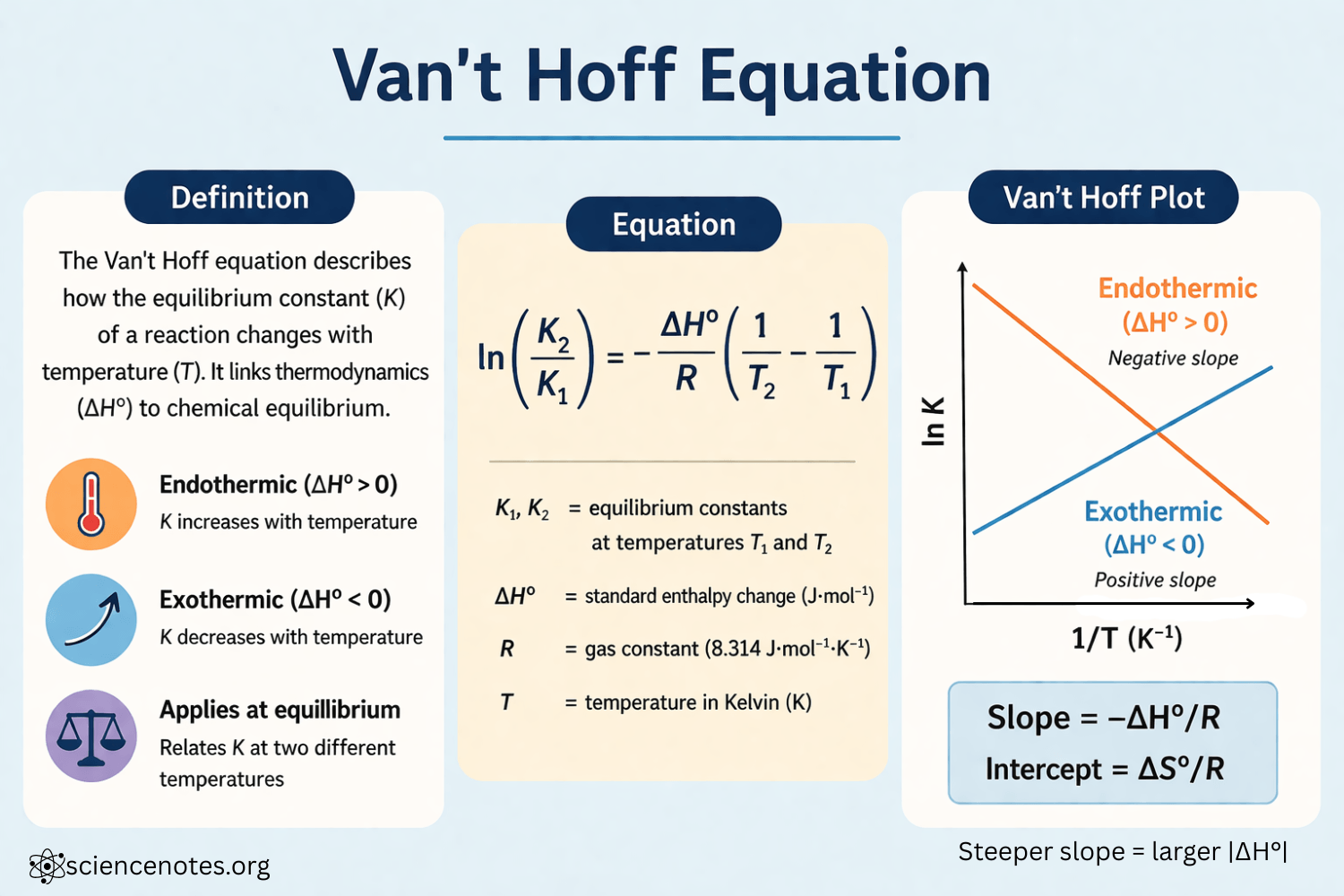
The Van’t Hoff equation describes how the equilibrium constant of a chemical reaction changes with temperature, linking thermodynamics (enthalpy) to equilibrium behavior. It is one of the most important relationships in physical chemistry because it allows chemists to determine reaction enthalpy and predict how temperature shifts equilibrium.
Key Takeaways: Van’t Hoff Equation
- The Van’t Hoff equation relates equilibrium constant (K) to temperature (T).
- It connects thermodynamics and equilibrium through enthalpy change (ΔH°).
- A positive ΔH° (endothermic) means K increases with temperature.
- A negative ΔH° (exothermic) means K decreases with temperature.
- A Van’t Hoff plot (ln K vs 1/T) yields a straight line whose slope gives ΔH°.
- The equation assumes ΔH° is constant over the temperature range.
- It is widely used in chemical equilibrium, biochemistry, environmental chemistry, and materials science.
What Is the Van’t Hoff Equation?
The Van’t Hoff equation expresses how the equilibrium constant of a reaction depends on temperature. It originates from combining the Gibbs free energy equation with thermodynamic definitions.
At equilibrium:
and
Combining and rearranging leads to the Van’t Hoff relationship.
The Van’t Hoff Equation
The two most common forms of the Van’t Hoff equation are the differential form and integrated form:
Differential Form
This form shows how the natural log of the equilibrium constant changes with temperature.
Integrated Form
Where:
- = equilibrium constants at temperatures
- = gas constant (8.314 J·mol⁻¹·K⁻¹)
- = temperature in Kelvin
- = standard enthalpy change
Historical Background
The equation is named after Jacobus Henricus van ’t Hoff, a pioneer of physical chemistry and the first Nobel Prize winner in Chemistry (1901). He developed this relationship in the late 19th century while studying chemical equilibria and osmotic pressure. His work established a quantitative link between thermodynamics and chemical equilibrium, forming a cornerstone of modern chemical thermodynamics.
Sign Conventions and Units
Correct sign conventions and units are essential when using the Van’t Hoff equation.
Key points:
- ΔH° units:
Must be in J/mol (convert from kJ/mol if needed) - Temperature:
Must be in Kelvin (K) - Gas constant (R):
Use consistent units, typically:
R = 8.314 J·mol⁻¹·K⁻¹ - Sign of ΔH°:
- Positive → endothermic → K increases with T
- Negative → exothermic → K decreases with T
- Logarithms:
The equation uses natural logarithms (ln), not base-10 logs
| Quantity | Meaning |
|---|---|
| K | Equilibrium constant |
| ΔH° | Enthalpy change |
| ΔS° | Entropy change |
| R | Gas constant |
| T | Temperature (K) |
Common mistakes:
- Using Celsius instead of Kelvin
- Forgetting to convert kJ to J
- Mixing units for R and ΔH°
- Using log instead of ln
Careful attention to units and signs ensures correct results and interpretation.
Worked Example Problems
Example 1: Finding K at a New Temperature
A reaction has:
- at 298 K
- Find at 350 K
Step 1: Convert units
Step 2: Apply Van’t Hoff equation
Step 3: Solve
Interpretation:
K increases significantly, confirming the reaction is endothermic.
Example 2: Determining ΔH° from Data
Given equilibrium constants:
- at 300 K
- at 320 K
Interpretation:
The reaction is endothermic.
The Van’t Hoff Isotherm
The Van’t Hoff isotherm relates equilibrium constant to Gibbs free energy at a constant temperature:
This equation allows calculation of equilibrium constants from thermodynamic data and is often used alongside the Van’t Hoff equation to analyze temperature effects.
The Van’t Hoff Plot
A Van’t Hoff plot graphs:
- y-axis:
- x-axis:
Linear Form
Interpretation
- Slope = −ΔH∘/R
- Intercept = ΔS∘/R
From the slope:
Endothermic vs Exothermic
- Endothermic reactions (ΔH° > 0):
- Negative slope
- K increases with temperature
- Exothermic reactions (ΔH° < 0):
- Positive slope
- K decreases with temperature
This method is widely used in:
- Environmental chemistry (gas solubility)
- Physical chemistry labs
- Biochemistry (protein folding, ligand binding)
Derivation of the Van’t Hoff Equation
The Van’t Hoff equation follows directly from combining two fundamental thermodynamic relationships.
Start with the Gibbs free energy equation:
and the thermodynamic definition of free energy:
Set the two expressions equal:
Rearrange to isolate lnK:
This is the linear form of the Van’t Hoff equation.
To obtain the differential form, differentiate both sides with respect to temperature:
This result is the differential Van’t Hoff equation, which shows how the equilibrium constant changes with temperature.
Common Assumptions
The Van’t Hoff equation relies on several simplifying assumptions:
- ΔH° is constant over the temperature range
- The reaction reaches true equilibrium
- Ideal behavior (especially for gases and dilute solutions)
- No phase changes or competing reactions occur
If ΔH° varies significantly with temperature, more advanced models are required.
When the Van’t Hoff Equation Breaks Down (Limitations)
The Van’t Hoff equation is an approximation that works best under ideal conditions and over relatively small temperature ranges.
Key limitations include:
- Temperature dependence of ΔH°
The equation assumes ΔH° is constant, but in reality, enthalpy often changes with temperature due to heat capacity differences. - Non-ideal behavior
Real systems may deviate from ideality, especially at high concentrations or pressures. - Phase changes
If a substance changes phase (solid, liquid, gas) over the temperature range, the equation may no longer apply. - Coupled or competing equilibria
Multiple reactions occurring simultaneously can distort the apparent equilibrium constant.
A more accurate treatment accounts for heat capacity:
This correction is important in advanced thermodynamic calculations.
Activities vs Concentrations
Strictly speaking, the equilibrium constant in the Van’t Hoff equation is defined in terms of activities, not concentrations.
- Activity (a) accounts for non-ideal behavior:
a = γ⋅c where is the activity coefficient and c is concentration. - The true equilibrium expression is:
In many cases:
- Dilute solutions: activity ≈ concentration, so the approximation is valid
- High concentrations or ionic solutions: activity coefficients deviate from 1, and using concentration introduces error
This distinction becomes important in:
- Electrochemistry
- High ionic strength solutions
- Industrial chemical systems
Uses of the Van’t Hoff Equation
Chemists use the equation in many areas:
- Determining enthalpy changes experimentally
- Predicting temperature effects on equilibrium
- Designing industrial chemical processes
- Studying biochemical equilibria (enzyme binding, protein folding)
- Environmental chemistry, such as gas solubility in water
- Materials science, including phase equilibria
Connection to Le Châtelier’s Principle
Le Châtelier’s principle predicts how equilibrium shifts in response to temperature changes. The Van’t Hoff equation provides the quantitative explanation behind this principle.
- Endothermic reactions (ΔH° > 0):
Increasing temperature increases K, shifting equilibrium toward products. - Exothermic reactions (ΔH° < 0):
Increasing temperature decreases K, shifting equilibrium toward reactants.
Le Châtelier’s principle describes the direction of the shift, while the Van’t Hoff equation calculates the magnitude of the change.
Related Concepts
Van’t Hoff Factor (i)
The Van’t Hoff factor describes the number of particles formed when a substance dissolves:
Examples:
- NaCl → i ≈ 2
- CaCl₂ → i ≈ 3
This factor is important in colligative properties such as boiling point elevation and freezing point depression.
Relationship to Other Thermodynamic Quantities
- Connects to Gibbs free energy
- Complements Le Châtelier’s principle
- Related to entropy changes (ΔS°) through the intercept of Van’t Hoff plots
Common Misconceptions
- “K changes randomly with temperature”
K changes predictably according to ΔH°. - “All reactions have constant ΔH°”
ΔH° often varies, especially over large temperature ranges. - “A larger K always means faster reaction”
K describes equilibrium position, not reaction rate. - “Van’t Hoff equation applies to all conditions”
It works best under ideal or near-ideal conditions.
FAQs
What does the Van’t Hoff equation tell you?
It shows how equilibrium shifts with temperature and allows calculation of ΔH°.
Why use ln K instead of K?
Taking the natural log linearizes the relationship, making analysis easier, especially for plotting.
Can the Van’t Hoff equation determine entropy?
Yes, using a Van’t Hoff plot, the intercept gives ΔS°.
What happens if ΔH° = 0?
K does not change with temperature.
Is the Van’t Hoff equation exact?
No, it is an approximation that assumes ΔH° is constant.
How is it different from the Arrhenius equation?
The Van’t Hoff equation relates equilibrium, while the Arrhenius equation describes reaction rates.
| Feature | Van’t Hoff Equation | Arrhenius Equation |
|---|---|---|
| Focus | Equilibrium | Reaction rate |
| Variable | K | k |
| Key parameter | ΔH° | Activation energy |
| Plot | ln K vs 1/T | ln k vs 1/T |
Summary
The Van’t Hoff equation provides a powerful link between thermodynamics and equilibrium. By relating temperature to the equilibrium constant, it allows chemists to predict reaction behavior, determine enthalpy changes, and analyze experimental data through Van’t Hoff plots. It remains a foundational tool across chemistry, from classroom problems to advanced research.
References and Further Reading
- Atkins, Peter; De Paula, Julio (2006). Physical Chemistry (8th ed.). W. H. Freeman and Company. ISBN 978-0-7167-8759-4.
- Cooper, Alan (2018). Roberts, Gordon; Watts, Anthony (eds.). “Van’t Hoff Analysis and Hidden Thermodynamic Variables”. Encyclopedia of Biophysics. Berlin, Heidelberg: Springer. doi:10.1007/978-3-642-35943-9_10066-1. ISBN 978-3-642-35943-9.
- Ives, D. J. G. (1971). Chemical Thermodynamics. University Chemistry. Macdonald Technical and Scientific. ISBN 978-0-356-03736-3.
- Monk, Paul (2004). Physical Chemistry: Understanding our Chemical World. Wiley. ISBN 978-0471491811.