

Turn your classroom or kitchen into a science lab filled with color, fizz, and glowing fun! The Love Potion Lab is a Valentine’s Day science activity where students become potion masters, exploring chemistry through cleverly themed experiments. Each potion demonstrates a real scientific principle, using common and safe ingredients. Great for schools, homeschoolers, science clubs, or family fun.
Key Takeaways: Love Potion Lab
- Students explore real chemical concepts through Valentine-themed experiments.
- Activities are hands-on, colorful, and safe for grades 3–10.
- Projects include color changes, bubbling reactions, glowing liquids, and more.
- Flexible format: Do one project or set up rotating stations.
- Includes printable labels and observation sheet options.
Learning Objectives
Students will:
- Conduct hands-on experiments using safe materials
- Learn and apply scientific concepts like pH, density, and surface tension
- Make predictions and observe chemical changes
- Connect science with creativity and holidays
Project Setup
Recommended Format: Set up 3–5 potion stations. Each one includes:
- A clever name and Valentine’s theme
- A fun visual or interactive effect
- A short science explanation
- Printable labels or take-home notes
You can print potion recipe cards, blank labels for student-designed names, and optional Valentine cards.
Age Range: Grades 3–10
Time per Station: 10–15 minutes
Prep Time: 20–40 minutes
Safety Note: Adult supervision required, especially when handling acids or UV light.
Potion Recipes, Instructions, and Science
1. Color-Changing Love Elixir
Effect: Changes from pink to purple to blue
Science: pH indicators
Ingredients:
- Red cabbage juice (or phenolphthalein in alcohol)
- Baking soda solution (1 tsp baking soda in 1/2 cup water)
- Vinegar or lemon juice
- Clear cups or beakers
- Spoons or droppers
Instructions:
- Pour about 1/4 cup of cabbage juice into a clear cup.
- Add a few drops of baking soda solution. Stir and observe the color shift.
- Now add a few drops of vinegar. Observe how the color changes again.
- Repeat to cycle back and forth between colors.
How It Works:
Anthocyanins in red cabbage act as pH indicators. They turn blue/green in bases (baking soda), and pink/red in acids (vinegar). This demonstrates how pH affects chemical structure and color.
2. Bubbling Hearts Potion
Effect: Fizzy bubbling reaction
Science: Acid-base reaction and gas evolution
Ingredients:
- Baking soda
- Vinegar or lemon juice or citric acid crystals
- Red or pink food coloring
- Heart-shaped mold or small beaker
- Spoon or dropper
Instructions:
- Add 1–2 teaspoons of baking soda to a small container.
- Mix a few drops of food coloring into the vinegar.
- Use a dropper to add vinegar to the baking soda.
- Watch the bubbling reaction!
- Try different amounts to compare fizz intensity.
How It Works:
The acid and base neutralize each other, releasing carbon dioxide gas. The gas forms bubbles, creating a fizzy explosion of color and sound that resembles a magical love potion. It’s perfect for Valentine chemistry.
3. Shimmering Solubility Sparkle
Effect: Glitter floats and swirls between layers
Science: Density and immiscibility of liquids
Ingredients:
- Clear plastic bottle or test tube
- Water
- Vegetable oil
- Pink or red glitter
- Optional: red food coloring
Instructions:
- Fill the bottle halfway with water. Add food coloring if desired.
- Sprinkle in glitter (about 1/2 tsp).
- Slowly pour vegetable oil on top to fill the rest of the bottle.
- Seal the bottle and gently tip it back and forth to watch the glitter swirl.
How It Works:
Water and oil don’t mix due to polarity differences. The glitter may float or sink depending on its density and the viscosity of the liquids. The separation creates a “liquid lava lamp” effect.
4. Glowing Love Tonic
Effect: Glows under blacklight
Science: Fluorescence
Ingredients:
- Tonic water (must contain quinine)
- Clear plastic cups or test tubes
- UV/blacklight
Instructions:
- Pour tonic water into a clear cup.
- Dim the lights in the room.
- Shine a blacklight on the liquid and observe the glow.
- For extra fun, try adding glow-in-the-dark paint to decorate the cup.
How It Works:
Quinine in tonic water fluoresces under UV light, emitting a bluish glow. This is an example of fluorescence, where substances absorb UV and emit visible light.
5. Floating Heart Illusion
Effect: Drawn heart lifts and floats
Science: Solubility and surface tension
Ingredients:
- Dry erase marker (must be non-permanent)
- Smooth glass or ceramic plate
- Room temperature water
- Cup for pouring
Instructions:
- Use the marker to draw a heart on the dry plate surface.
- Wait 10 seconds for the ink to dry.
- Slowly pour a thin stream of water around and over the drawing.
- Watch as the heart detaches and floats on the water surface!
How It Works:
Dry erase marker ink is designed to lift easily. Water gets under the drawing and surface tension holds the ink together, making it float. This is a great example of hydrophobic materials and surface effects.
Printable and Take-Home Ideas
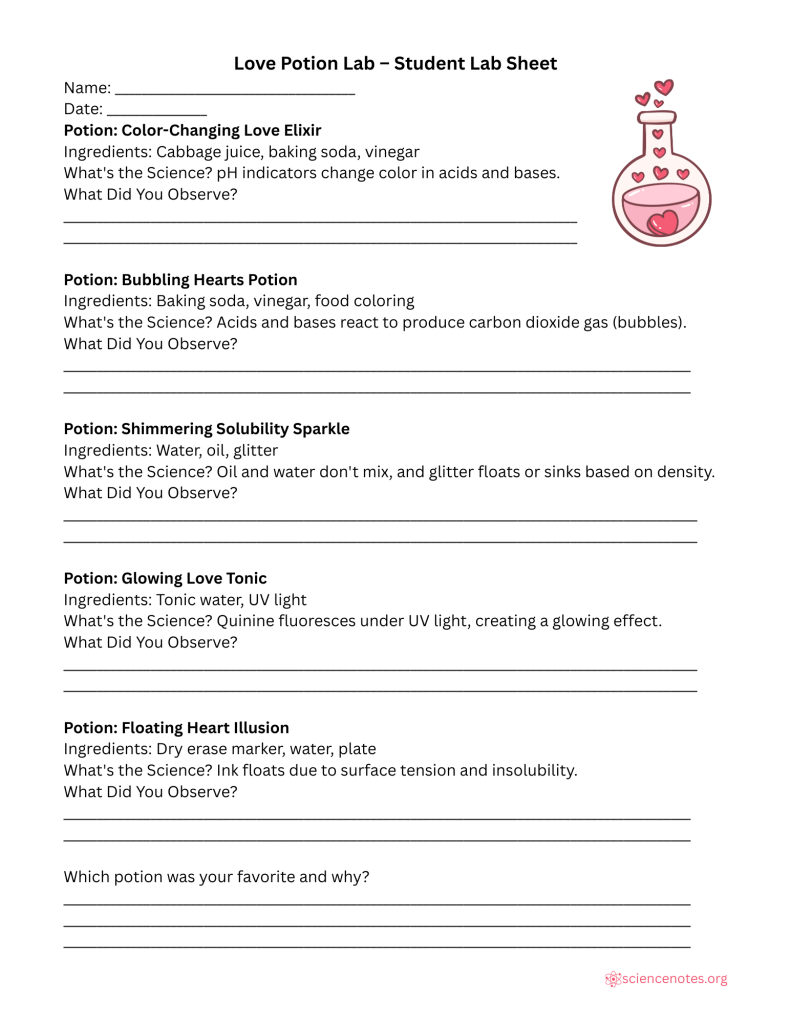
Lab Sheets
Download and print the student and teacher lab sheets that accompany the Love Potion activity:
- Student Version (PDF): Title, materials, steps, observations, science takeaway
- Teacher Version (PDF): Setup instructions, safety tips, learning outcomes
Labels and Valentine Cards
- Themed designs: hearts, beakers, test tubes
- Include puns like:
- “You’re the fizz to my pop”
- “You’re glowing, Valentine”
- “Love is a chemical reaction”
Station Signs and Posters
- Each station labeled with potion name and brief description
Take-Home Kits
- Glitter bottle for solubility
- Baking soda + citric acid packet with directions
- Printable observation sheet to repeat at home
Optional Extensions
- Writing Prompt: Create a story about a scientific love potion with unexpected effects.
- Cross-Curricular Links: Explore myths, Shakespeare, or historical alchemists.
- Data Collection: Measure reaction times, bubble heights, or pH color shifts.